


- Render’s transfer from pure 3D rendering to AI computing via Dispersed.com opens up a a lot bigger addressable market associated to mannequin coaching, inference, and robotics workloads.
- Onboarding enterprise-grade NVIDIA H200 and AMD MI300X GPUs will increase reliability with studios and academic establishments whereas sustaining the advantages of distributed prices.
- With sustained 85-95% node utilization and evolving burnmint dynamics, actual demand progress, moderately than hypothesis, would be the main driver of upside in the direction of $5-8.
Render Community traded at $2.435, rebounding from December lows of $1.53, with 2026 bringing a strategic shift from 3D rendering to AI computing infrastructure via the Dispersed.com platform launched in December 2025, with enterprise-grade NVIDIA H200 and AMD MI300X GPUs concentrating on AI studios and robotics firms. , with 5,600 node operators attaining 85-95% utilization. 65 million cumulative frames have been rendered to exhibit real-world utilization, and the VR/AR toolset will probably be prolonged to spatial computing in mid-2026.
Restoration try seems in technical setup
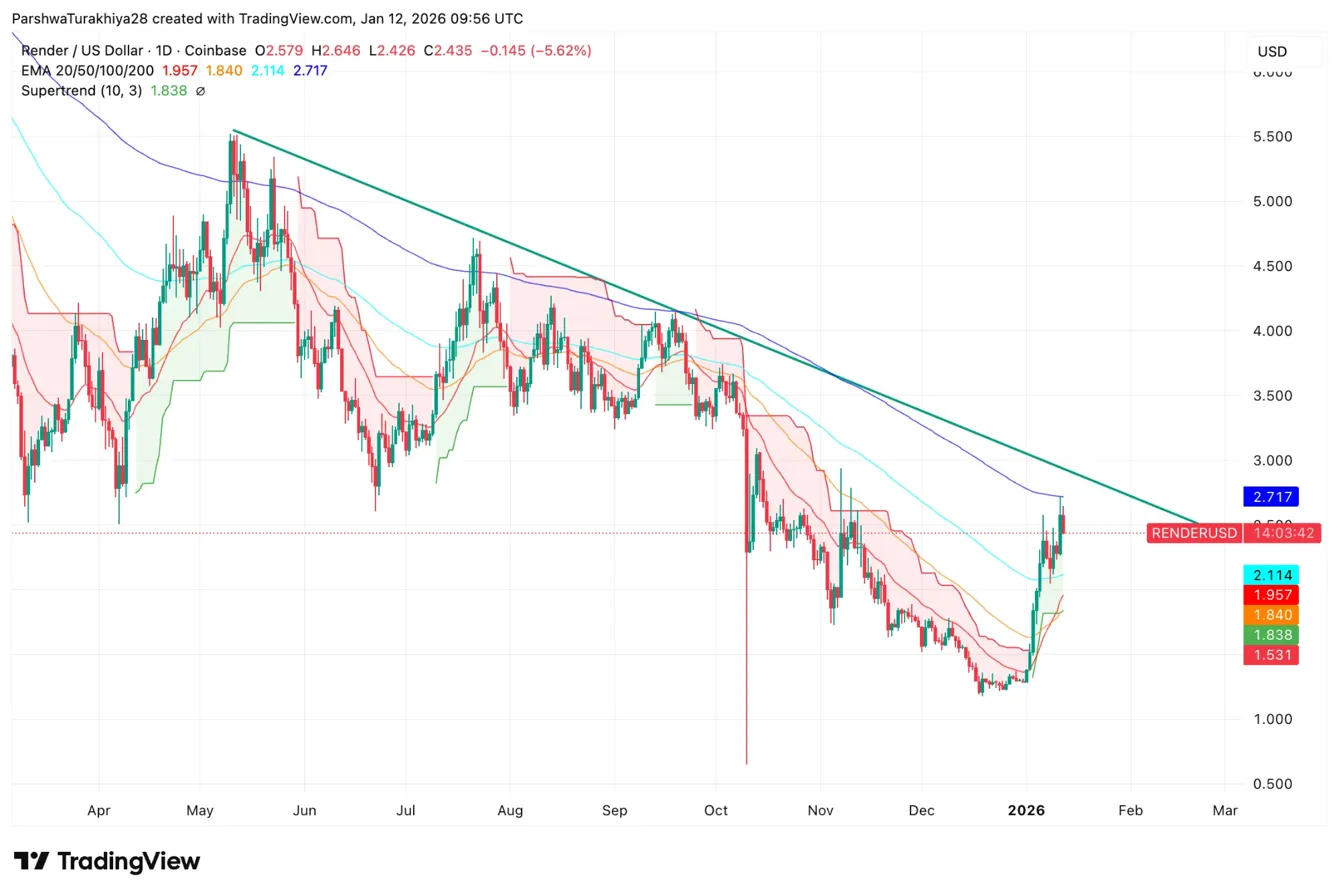
The $2.435 lender rebounds from the $1.53 low and checks resistance at $2.717 (200 EMA). Under the EMA, it has a blended construction at $1.957/$1.840/$2.114/$2.717. The $1.838 supertrend confirms that help holds. The long-term downtrend from the March excessive of $5.30 stays intact.
Assist value is $1.957 to $1.838. The bulls want sustained quantity above $2.717 to interrupt the downtrend from $3.50 to $4.00. Failure dangers a retest of $1.957 or a low of $1.53.
4 main developments
Extending AI computing past rendering
The Dispersed.com platform (launched in December 2025) aggregates distributed GPUs for 3D rendering in addition to AI mannequin coaching and inference. The subsequent section will characteristic enterprise-grade NVIDIA H200 (141GB HBM3e reminiscence for large-scale AI fashions) and AMD MI300X GPUs focused at AI studios and robotics firms.
This pivot addresses the large alternative that conventional rendering represents a distinct segment area whereas AI computing demand is exploding. Infrastructure duplication exists. Each rendering and AI workloads require massively parallel GPU computation. Leveraging current GPU networks for AI permits you to dramatically broaden your use circumstances and income streams with minimal infrastructure modifications. Though inference prices are lowering, they continue to be a major burden for enterprises. Render gives a horny various to AWS and Google Cloud.
Benefits of decentralized prices
5,600 node operators with 85-95% utilization present a scalable and cost-effective various to AWS. Over 65 million cumulative frames rendered characterize tangible computing exercise. Excessive utilization signifies real demand moderately than speculative infrastructure. GPU house owners settle for decrease revenue margins than industrial knowledge facilities, which require returns on capital-intensive investments, and monetize tools that sits idle between gaming classes and initiatives.
Associated: 2026 Canton Value Prediction: DTCC Treasury Tokenization and $6 Trillion Asset Processing Goal at $0.25-0.50
For customers, this implies rendering and compute prices are considerably decrease than AWS, Google Cloud, and Azure, making them enticing economics for impartial creators, startups, and cost-conscious enterprises.
Establishments eligible for enterprise GPU integration
Concentrate on enterprise-grade GPUs in mid-2026 to handle reliability gaps that hinder institutional adoption. Studios and AI firms are hesitant to entrust vital workloads to consumer-grade GPUs, the place reliability and constant efficiency are unknown.
NVIDIA H200 delivers cutting-edge AI acceleration that’s considerably higher than client RTX playing cards. Incorporating knowledge center-grade {hardware} permits you to compete immediately with industrial cloud suppliers for performance whereas sustaining value benefits via a distributed structure.
Increasing generative AI and VR/AR
The platform integrates main GPU rendering engines (OctaneRender, Redshift, Blender Cycles) and generative AI instruments from Runway, Black Forest Labs, Luma Labs, and Stability AI to supply a unified platform for digital creation workflows.
Creators are more and more combining conventional 3D rendering with AI-generated parts (text-to-image, image-to-video, AI upscaling). VR/AR toolset growth in mid-2026 will goal immersive content material and robotics simulation utilizing Unreal Engine and OTOY’s OctaneRender partnership.
The connection between Burn Mint Tokenomics and OTOY
In burn-mint equilibrium, deflationary pressures develop as utilization will increase. Present emissions: 500,000 renders to nodes per 30 days, and as much as 50,000 burns per 30 days from jobs. The RNP-022 proposal addresses tokenomics changes that might introduce staking mechanisms to alleviate promoting strain.
Sustainability depends upon growing utilization charges over emissions. This can be a basic threat if computing calls for don’t materialize. As our largest ecosystem accomplice, OTOY supplies vital rendering software program and core infrastructure. OctaneRender customers can route duties via the render community. This supplies a built-in person base, however introduces dependency dangers.
Competitors with cloud giants
AWS, Google Cloud, and Azure provide turnkey GPU computing with enterprise SLAs, technical help, and seamless cloud integration. That benefit is troublesome to duplicate in a decentralized community.
Different DePIN networks (Beam, FedML, Nosana, Prime Mind) fragment the market. The historic partnership from 2023 to 2024 didn’t lead to continued use on account of restricted demand and early market circumstances.
Render Value Forecast: Quarterly Breakdown
Q1 2026: $2.40 – $3.80 Dispersed.com AI Compute Adoption Metrics, Enterprise GPU Onboarding Launch, Node Operator Development. Breaking above $2.717 in the direction of $3.50-3.80.
Q2 2026: $3.00 to $5.00 NVIDIA H200/AMD MI300X integration, AI studio partnership, and VR/AR toolset launch. If you wish to speed up adoption, attempt $4.00 to $5.00.
Q3 2026: $3.50 – $6.50 Enterprise buyer traction, occupancy charges maintained at 85-95%, burn-mint equilibrium shifting in the direction of deflation. Goal is $5.50 to $6.50.
This fall 2026: $4.00 – $8.00 12 months-end AI computing market share evaluation, spatial computing adoption. As much as $7.00-$8.00 requires Breakthrough Enterprise Settlement.
2026 Rendering Value Forecast Desk
| quarter | low | costly | important catalyst |
| Q1 | $2.40 | $3.80 | AI Compute Metrics, Enterprise GPU |
| 2nd quarter | $3.00 | $5.00 | H200/MI300X, studio, VR/AR instruments |
| Q3 | $3.50 | $6.50 | Company traction and leverage |
| This fall | $4.00 | $8.00 | market share, spatial computing |
Portfolio affect
- Base case ($4.00 to $6.00): AI Computing Adoption Slowly Will increase with 7,000-8,000 Node Operators, Sustained Over 90% Utilization, Over 50 Shoppers with Enterprise GPUs, Burnmint Shifts in the direction of Equilibrium, VR/AR Exhibits Reasonable Traction, $2.717 Breaks in the direction of $5.00-$6.00.
- Bull case ($7.00-$8.00): Breakthrough enterprise offers with main AI studios, 10,000+ node operators, 95%+ utilization, H200/MI300X attracts organizational workloads, burn-mint achieves web deflation, spatial computing accelerates, and sustained break above $7.00.
- Bear case ($1.50-$2.80): Enterprise adoption disappoints, AWS maintains dominance, utilization falls to 70-80%, emissions outpace combustion, VR/AR market stays area of interest, help break at $1.957 widens decline.
Disclaimer: The knowledge contained on this article is for informational and academic functions solely. This text doesn’t represent monetary recommendation or recommendation of any type. Coin Version is just not chargeable for any losses incurred on account of the usage of the content material, merchandise, or providers talked about. We encourage our readers to do their due diligence earlier than taking any motion associated to our firm.